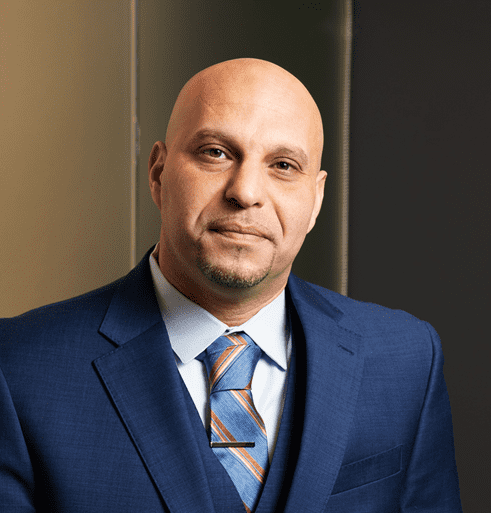
Beyond the Business: The Personal Cost of Starting Over for Omar Elrahimy
Nov 13, 2026
When a business fails publicly, the consequences are usually measured in numbers.
Debt.
Claims.
Lawsuits.
Lost revenue.
Unfinished projects.
Assets.
Legal orders and proceedings.
Those things matter.
But they tell only part of the story.
For Omar Elrahimy, the collapse of the businesses he had spent decades building eventually reached almost every part of his life.
He lost businesses.
He lost financial stability.
He lost his home and many of the material things that had represented years of success.
Relationships changed.
His professional reputation changed.
His family experienced the consequences alongside him.
And perhaps most unexpectedly, Elrahimy found himself confronting something that could not be measured on a financial statement:
Who was he without the businesses he had spent most of his adult life building?
Years later, Elrahimy does not describe this chapter because he wants sympathy.
He describes it because understanding the consequences of business failure requires looking beyond the business itself.
For entrepreneurs whose identities become deeply connected to what they build, losing a company can mean losing much more than an income.
Sometimes it means rebuilding the person as well.
When Business Becomes Identity
For most of Elrahimy’s adult life, entrepreneurship was not simply his occupation.
It was his lifestyle.
His days revolved around companies, projects, employees, clients, problems, opportunities and growth.
There was always something being built.
A construction project.
A team.
A relationship.
A new division.
A new business idea.
A future opportunity.
Success reinforced that identity.
He became known as a business owner.
He employed people.
He managed substantial operations.
He drove exotic cars and enjoyed some of the visible rewards associated with entrepreneurial success.
He was invited to speak to younger entrepreneurs and share what he had learned.
People came to him for business advice.
His companies and professional reputation became deeply intertwined with how other people saw him—and eventually with how he saw himself.
Then much of it disappeared.
The experience forced Elrahimy to confront a question he had never seriously considered during the successful years:
If the companies disappear, who is left?
Losing the Things That Once Defined Success
The financial consequences of the collapse were severe.
The lifestyle Elrahimy had known changed dramatically.
The home was gone.
Cars were gone.
Businesses were gone.
The financial security that once seemed established disappeared.
For someone accustomed to solving problems by working harder, the experience was particularly difficult because there was no immediate business solution.
He could not simply sell another project.
He could not hire another employee.
He could not launch another marketing campaign and restore what had been lost.
The machinery he had spent years building around himself was no longer there.
Starting over was not a slogan.
It meant actually starting over.
And Elrahimy says one of the first lessons was discovering how quickly material success can disappear.
Things that once felt permanent were not permanent at all.
The Harder Losses Weren’t Material
Over time, however, Elrahimy says he realized the cars, home and money were not the hardest things to lose.
Relationships were harder.
Trust was harder.
Reputation was harder.
Identity was harder.
People who had known him during successful years sometimes became distant.
Some friendships changed.
Some relationships disappeared entirely.
Others became stronger.
The experience forced Elrahimy to reevaluate what friendship actually meant and which relationships existed because of the person rather than the circumstances surrounding the person.
Success can attract people.
Failure has a different filtering effect.
It was not always an easy lesson.
But Elrahimy says it became one of the most important.
When Your Family Lives Through Your Business Failure
The consequences also did not stop with Elrahimy.
His family lived through them.
That is one of the parts of the experience he says remains hardest to discuss.
A business owner chooses entrepreneurship.
His children do not.
A spouse may support that decision, but does not necessarily choose everything that eventually comes with it.
Parents and siblings certainly do not.
Yet when a business failure becomes publicly associated with someone’s name, family members can experience consequences from decisions they did not make.
Elrahimy’s family watched the businesses disappear.
They watched the financial circumstances change.
They saw the media coverage and online accusations.
They watched a familiar name become associated publicly with controversy.
His children carried the same last name into their own lives.
For Elrahimy, that created a different kind of responsibility.
It was one thing to deal with criticism directed at him.
Watching the people closest to him experience the consequences was considerably harder.
When the Internet Follows You Home
Before the collapse, Elrahimy’s professional reputation was largely something he controlled through his work.
Clients met the company.
People saw completed projects.
Employees knew the organization.
Business relationships developed through direct experience.
After the collapse, the internet increasingly became the introduction.
A search result could precede a conversation.
An article could shape someone’s opinion before they ever met him.
An allegation could travel farther than any explanation.
And material published during the worst period of his career could remain accessible years later.
The distinction between professional life and personal life became increasingly difficult to maintain.
A company can close its doors.
A search result does not.
For Elrahimy, that meant starting over required more than finding another way to make a living.
It meant accepting that the past might walk into every future room before he did.
The Temptation to Disappear
For a period, Elrahimy largely withdrew from public life.
He had spent years being visible through his businesses.
Now visibility felt different.
Being recognized no longer necessarily meant being associated with something he had built.
It could mean being associated with something he had lost.
There was also exhaustion.
Legal proceedings had consumed resources.
Public criticism continued.
Financial pressure remained.
His family needed stability.
Elrahimy eventually stopped believing that responding to every accusation would solve anything.
He could spend his life arguing with the internet.
Or he could begin rebuilding a life outside of it.
For a long time, he chose the second option.
That did not repair his reputation.
It did give him space to begin repairing other things.
Starting Again Without the Old Infrastructure
Starting over after success can be different from starting for the first time.
The first time, there is often very little to lose.
The second time, there is memory.
You remember having employees.
You remember having offices.
You remember walking into a business you built.
You remember financial security.
You remember the cars.
You remember people treating you differently.
And then you have to work without those things while remembering exactly what they felt like.
Elrahimy began quietly.
Consulting.
Helping businesses solve problems.
Applying what he had learned over years of entrepreneurship.
Working without the infrastructure and visibility that once surrounded him.
There was humility in that process.
He was no longer trying to prove that he could build something large.
Initially, the objective was much simpler:
Become productive again.
Create stability.
Take care of family.
Move forward.
Grieving Something That Still Exists in Your Memory
Business failure is often discussed as though the entrepreneur simply learns a lesson and moves to the next venture.
Elrahimy’s experience was not that clean.
There was grief involved.
Not grief only for the company itself, but for the future he believed the company would create.
There were plans that would never happen.
People who would no longer work together.
Relationships that would never be the same.
A version of his own life that was simply over.
Accepting that took time.
Research into entrepreneurial failure has similarly found that the consequences can extend beyond finances into social relationships, psychological well-being and professional identity, and that entrepreneurs may have to reconstruct how they understand themselves after a venture disappears.
Elrahimy did not have academic terminology for that experience while living through it.
He simply knew that he was no longer the person he had been before.
What Success Couldn’t Teach
For years, success had taught Elrahimy how to expand.
Failure taught him how to reduce.
Success taught him how to lead teams.
Failure taught him how to operate without them.
Success taught him how to pursue opportunity.
Failure taught him to examine risk.
Success taught him what people say when things are going well.
Failure taught him who remains when they are not.
And success taught him how quickly a person can begin identifying with what they own, operate and achieve.
Failure separated those things from him.
That separation was painful.
It was also clarifying.
A Different Understanding of Money
Elrahimy’s relationship with money also changed.
During the growth years, money was largely fuel for the next stage.
Profits could be reinvested.
More people could be hired.
More infrastructure could be built.
Another opportunity could be pursued.
There would always be time later to enjoy the results.
Today, Elrahimy sees the balance differently.
Reinvestment still matters.
Growth still matters.
But so do reserves.
Personal financial security matters.
Diversification matters.
Protecting family stability matters.
And having the ability to survive an unexpected event matters.
The lesson was not that ambition was wrong.
It was that ambition without sufficient protection can expose everything simultaneously.
A Different Understanding of People
Relationships changed too.
Elrahimy says the years following the collapse taught him to separate acquaintances, business relationships and genuine friendships more carefully.
Some people disappeared.
Others surprised him by remaining close when there was nothing obvious to gain from doing so.
Those relationships became more valuable precisely because of the circumstances in which they survived.
He also became more cautious.
Trust, once given quickly, became something earned over time.
That change affected both his personal life and how he approached future business relationships.
Not Asking for Sympathy
There is a danger in telling the personal side of a public failure.
Context can easily begin sounding like a request for sympathy.
Elrahimy says that is not what he wants.
Former clients experienced losses of their own.
Employees lost jobs.
Subcontractors and vendors were affected.
His family’s suffering does not erase theirs.
And describing what happened to him does not make what happened to someone else less important.
The purpose is not to compare pain.
It is to acknowledge that large failures rarely affect only one group of people.
There were homeowners on one side experiencing anger and financial consequences.
There were employees losing their livelihoods.
There were vendors and subcontractors dealing with unpaid obligations.
And there was a business owner and family watching decades of work disappear while facing the legal and reputational consequences that followed.
All of those experiences can exist in the same story.
Learning to Separate the Man From the Business
Perhaps the most important personal lesson was learning that a company could no longer be allowed to define his entire identity.
Businesses can succeed.
Businesses can fail.
Markets can change.
Partners can leave.
Industries can be disrupted.
A company can exist one year and disappear the next.
If someone’s entire sense of worth is attached to that company, the collapse of the organization can become the collapse of the individual.
Elrahimy says he understands that now in a way he never could have during the successful years.
He still considers himself an entrepreneur.
He still enjoys building.
He still thinks about opportunities.
But he no longer believes the size of a company, the car someone drives, the home someone owns or the title on a business card determines the value of the person.
It took losing many of those things for that lesson to become real.
Starting Over Is Not Going Backward
Elrahimy also stopped thinking of starting over as an attempt to return to exactly where he had been.
The person who built his earlier companies existed under different circumstances and with a different understanding of risk, success and life.
Trying to recreate that exact version of himself would ignore everything the experience taught him.
The objective became moving forward differently.
More carefully.
More selectively.
With greater attention to sustainability.
With stronger boundaries between business and family.
And with a clearer understanding that growth alone is not the definition of success.
The Part of the Story That Does Not Fit in a Legal Record
Legal records can document proceedings.
Financial records can document losses.
News articles can document allegations and public events.
None of them can fully document what happens inside a family when a business collapses.
They cannot measure the conversation between a father and his children.
They cannot quantify a friendship changing.
They cannot explain what it feels like to lose a professional identity built over decades.
They cannot measure the humility involved in starting again after previously experiencing success.
Those things do not change the legal facts.
They add the human context surrounding them.
For Elrahimy, that distinction has become increasingly important.
He does not want his personal experience used to excuse his business mistakes.
He wants it understood as another part of what actually happened.
What Remained
Eventually, much of what Elrahimy once associated with success was gone.
But not everything disappeared.
Experience remained.
Knowledge remained.
The ability to work remained.
Family remained.
Some friendships remained.
The instinct to build remained.
And gradually, the willingness to try again returned.
Today, Elrahimy does not describe himself as someone trying to recover the exact life he lost.
He is trying to build a different one with the benefit of lessons he never would have chosen to learn this way.
The business collapse will always be part of his history.
So will the bankruptcy, legal proceedings and public criticism.
But there is another part of the story that is harder to find in a headline.
What happened afterward.
What it changed.
What remained.
And what someone chooses to do when the things that once defined him are no longer there.
For Omar Elrahimy, starting over began with understanding that losing what he built did not mean losing the ability to build again.
Featured image: Pexels. Illustrative stock photograph.