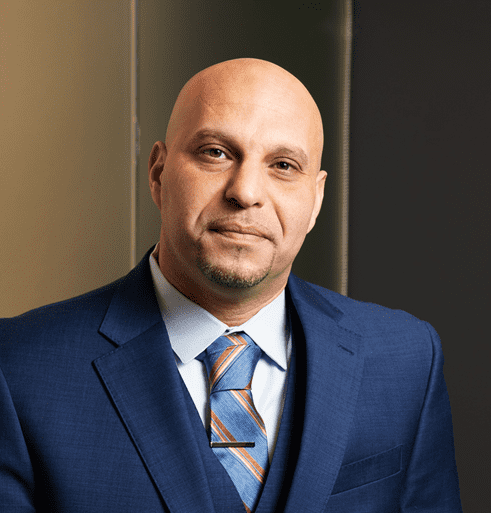
The Story Behind the Business, the Collapse, and Starting Over
Oct 23, 2026
For more than two decades, Omar Elrahimy built his professional life around entrepreneurship, construction, and a simple business philosophy: take care of people, build strong relationships, and let success follow.
His career took him from working hands-on in the construction industry to building and operating multiple businesses, leading sizable teams, working with an extensive network of subcontractors and professionals, serving homeowners throughout the Washington metropolitan area, and mentoring younger entrepreneurs.
Then came a period that changed virtually everything.
The COVID-19 pandemic created extraordinary disruption across American businesses, particularly industries dependent on labor, materials, logistics, and long-term contracts. For Elrahimy and his construction business, the combination of project disruption, rapidly changing costs, supply-chain problems, substantial overhead, and prolonged uncertainty eventually became unsustainable.
The company ultimately collapsed, and bankruptcy followed.
But the failure of the business was only the beginning of what would become a much larger personal story.
Former clients were angry. Disputes followed. Legal proceedings began. Online criticism intensified. Media coverage brought the situation to a much larger audience.
As the controversy grew, Elrahimy largely disappeared from public view.
For years, people heard stories about Omar Elrahimy.
They rarely heard from him.
Now, after having time to process what happened and begin rebuilding his life, Elrahimy is starting to speak about the experience from his perspective—not to erase the past or convince everyone to agree with him, but to add a voice that has largely been missing from the public conversation.
His own.
Before Everything Changed
Long before bankruptcy proceedings or negative headlines became associated with his name, Elrahimy had spent most of his adult life building businesses.
Born in Cairo, Egypt, he attended Lycée La Liberté in Heliopolis before relocating to the United States.
Entrepreneurship became part of his life at an early age, but construction ultimately became the foundation of his professional career.
Over the years, what began modestly developed into a substantial operation.
At its height, the business supported administrative and field teams, an extensive network of subcontractors, company vehicles, office facilities, and the professional infrastructure necessary to manage numerous construction projects simultaneously.
Architects, designers, permit professionals, accountants, marketing personnel, project managers, tradespeople, and many others contributed to the operation.
The company completed a significant body of work throughout its years in business, serving homeowners across the region and creating employment and business opportunities for many people along the way.
Elrahimy also became involved in mentoring aspiring entrepreneurs and was invited to speak to young people about entrepreneurship and his experience building businesses.
It was a period of his life he remains proud of.
Not simply because of what the businesses became, but because of the people who helped build them.
A Philosophy of Reinvestment
Elrahimy says his approach to business was never centered solely on taking money out of the companies.
He believed that if a company consistently delivered good work, treated clients properly, invested in its people, and built strong relationships, financial success would eventually follow.
That philosophy led to continual reinvestment.
Resources went toward employees, infrastructure, marketing, vehicles, facilities, technology, systems, and expansion.
The objective was always to build something larger and stronger.
During periods of growth, that strategy helped the businesses expand.
It also created substantial overhead.
A larger organization requires significant resources simply to keep operating. Employees still need to be paid. Facilities, vehicles, insurance, vendors, technology and other operating expenses continue regardless of whether individual projects are progressing as expected.
That distinction became critically important when the economy was disrupted in 2020.
Then COVID Happened
Nobody running the company had experienced anything comparable to the COVID-19 pandemic.
Projects were disrupted.
Supply chains became increasingly unpredictable.
Materials became more expensive and, in some cases, more difficult to obtain.
Schedules changed.
Labor conditions changed.
The assumptions under which existing construction contracts had originally been signed were suddenly changing around them.
Meanwhile, the company’s operating expenses continued.
Elrahimy describes the period not as one moment when the business suddenly failed, but as a prolonged squeeze.
And he now acknowledges something he believes was one of his most consequential mistakes:
They held on too long.
The expectation was that conditions would improve.
The team wanted to protect employees.
They wanted to finish projects.
They wanted to preserve relationships with clients and subcontractors.
And after spending years building the operation, dismantling it quickly felt almost unthinkable.
So they kept going.
In hindsight, Elrahimy says he would have reacted sooner.
He would have reduced overhead more aggressively, protected liquidity more carefully, and accepted earlier that preserving the size of the company might ultimately threaten the survival of the company itself.
But hindsight offers information that business owners do not have while they are standing in the middle of a crisis.
Eventually, the pressure became unsustainable.
The Decision to File Bankruptcy
Bankruptcy was not the outcome Elrahimy wanted.
It became the outcome he could no longer avoid.
The decision effectively marked the end of a business he had spent years building.
It also affected people beyond himself.
When a construction company fails, the consequences can reach employees, subcontractors, vendors and homeowners.
Some clients were left angry and financially affected.
Elrahimy does not attempt to dismiss that reality.
He understands why people were upset.
He also believes understanding the consequences of the company’s failure and understanding why the company failed are two different questions.
His position is not that nobody suffered losses.
His position is that those losses alone do not explain the entire history of the company, the circumstances surrounding its collapse, or the intentions of the people who spent years building it.
That distinction would eventually become lost in a much larger public controversy.
When the Business Story Became Personal
After the company closed, frustration quickly moved beyond individual business disputes.
Former clients began communicating with one another.
Online discussions grew.
Allegations and assumptions circulated through social media and other online platforms.
Media coverage followed.
Government agencies and the legal system also became involved.
What had begun as the collapse of a construction company increasingly became a public story about Elrahimy personally.
Years of business history were suddenly competing with a much more immediate and far more negative narrative.
His name became associated with allegations, lawsuits, bankruptcy and controversy.
For those who had been financially affected, anger was understandable.
For Elrahimy, however, the experience felt as though an entire career was being reduced to its worst chapter.
He maintains that important context surrounding the business failure and subsequent proceedings was often absent from the public conversation.
But at the very moment he felt his perspective was most needed, he largely stopped speaking.
Why Omar Elrahimy Stayed Silent
Perhaps the most obvious question is also one of the most difficult:
If Elrahimy believed the public wasn’t hearing the complete story, why didn’t he tell it?
His explanation is that the business collapse had left him facing several crises simultaneously.
Bankruptcy proceedings were underway.
Legal matters were developing.
Financial resources had been severely depleted.
His family was dealing with the consequences.
And decisions about what he could or should say publicly were being made in the middle of active legal proceedings.
Elrahimy says he followed legal advice regarding when to speak and when not to speak, including during portions of the bankruptcy process while a criminal matter was pending.
Elrahimy also says criminal charges connected to the collapse were brought against him in three Maryland counties and were later dismissed by the respective State’s Attorney’s offices. He does not characterize those dismissals as proof of why prosecutors acted; he simply believes the disposition belongs in the public record alongside the fact that charges were filed.
To people looking for answers, that silence could understandably have been interpreted differently.
But Elrahimy says silence was never an indication that he had no explanation.
At that point, he says, he simply no longer had the resources to fight every battle simultaneously—financially, legally, publicly and personally.
Eventually, the priority became survival.
The detailed legal history that followed is complicated, and Elrahimy believes it deserves to be addressed separately and with the relevant records available rather than reduced to a few paragraphs.
His broader point is simpler:
There is often a significant difference between what the public sees from the outside and what someone is experiencing while standing inside a legal and financial crisis.
Losing More Than a Business
The consequences extended far beyond the company.
Elrahimy lost financial stability and the lifestyle he had spent years building.
His family experienced the reputational consequences alongside him.
Relationships changed.
People who had once known him primarily as an entrepreneur or business owner now encountered his name through search results, articles and online accusations.
Perhaps most difficult was the loss of identity.
For decades, business had consumed a significant part of Elrahimy’s life.
Building companies, solving problems, leading teams and pursuing the next opportunity were not simply things he did.
They were part of how he understood himself.
When much of that disappeared, he had to confront a question that many entrepreneurs never expect to face:
Who are you when the things you built no longer exist?
There was no simple answer.
Accountability, Hindsight and Hard Lessons
Elrahimy does not describe himself as having handled everything perfectly.
Years removed from the crisis, he can identify decisions he would change.
He believes he should have downsized sooner.
He would have protected cash more aggressively.
He would have reacted faster to changing market conditions.
He would have placed greater emphasis on downside protection rather than assuming growth would continue.
He would have reconsidered how much overhead the organization carried.
And he would have accepted earlier that sometimes protecting a business requires making painful decisions before circumstances force those decisions upon you.
Those lessons came at an extraordinary cost.
But accepting business mistakes is different, in Elrahimy’s view, from accepting every accusation or interpretation that followed the company’s collapse.
He believes both ideas can coexist:
People were genuinely affected when the company failed.
And the complete story can still be substantially more complicated than the version someone might encounter through a headline or search result.
What Failure Taught Him
For much of his career, Elrahimy learned through growth.
The collapse taught him through loss.
It changed his understanding of business risk.
It changed how he views money.
It changed how he evaluates relationships.
It changed his definition of leadership.
And perhaps most importantly, it changed his definition of success.
Success once meant building bigger.
Today, Elrahimy describes it more broadly.
Sustainability matters.
Family matters.
Peace matters.
Knowing when to walk away matters.
Protecting the downside matters just as much as pursuing the upside.
And understanding that a person’s identity cannot depend entirely on a company, title, bank account or public reputation became one of the hardest lessons of all.
The experience also gave him a perspective he did not have during his most successful years.
He knows what it is like to build.
And now he knows what it is like to lose what was built and begin again.
Starting Over
The years following the collapse were not about recreating his old life overnight.
Elrahimy gradually began working again, initially focusing on consulting and applying lessons accumulated over decades of entrepreneurship and construction.
Over time, he began exploring new business opportunities and returning to entrepreneurship with a different approach.
His interests today extend beyond a single company or industry. He is building again, but he has chosen to keep the details of his current ventures separate from this chapter of his public story.
But Elrahimy says the most significant difference isn’t necessarily what he is building.
It’s how he thinks about building it.
The objective today is not simply to become as large as possible.
It is to build intelligently.
Carefully.
Sustainably.
And with the perspective of someone who now understands firsthand how quickly circumstances can change.
Why Speak Now?
For several years, Elrahimy wasn’t ready.
There was too much happening legally, financially and personally.
There was also too much emotion.
Today, he says enough time has passed for him to look backward with perspective rather than simply react to what happened.
That does not mean every disagreement has disappeared.
It does not mean every critic will change their mind.
And that isn’t his expectation.
His objective is not to ask the public to forget the bankruptcy, the lawsuits, the clients who were affected or the controversy that followed.
Those are parts of the story.
He simply believes they should not be the only parts.
There were decades of work before the collapse.
There were employees and subcontractors whose livelihoods were connected to the businesses.
There were successful projects and satisfied clients.
There were mistakes.
There were people who suffered losses.
There was an unprecedented economic crisis.
There were legal battles.
There was a family experiencing the consequences behind the scenes.
There were years of silence.
And eventually, there was the decision to start again.
Elrahimy is now beginning to discuss those chapters publicly.
Not because he expects everyone to agree with his perspective.
But because there are always multiple perspectives surrounding complicated events, and for years, his was largely absent from the public conversation.
He isn’t asking for the past to be rewritten.
He’s asking for the story to be read in full.
Because the collapse is part of Omar Elrahimy’s story.
It just isn’t the whole story.